 Chiara Bisio
KEYNOTE LECTURE
Advanced Functional Materials and Optical Spectroscopies for CBRNe Defense: From Threat Identification to Smart Mitigation
Chiara Bisio
Università del Piemonte Orientale, Italy
ABSTRACT
The effective management of Chemical, Biological, Radiological, and Nuclear (CBRNe) threats require integrated technological strategies capable of bridging rapid on-site detection with sustainable, non-destructive mitigation.
Conventional decontamination procedures often rely on aggressive stoichiometric reagents or thermal degradation, which present severe operational limitations, high environmental impact, and potential damage to sensitive equipment, textiles, and personnel. This contribution presents a comprehensive overview of how optical spectroscopic techniques (such as FTIR, Raman, and luminescence techniques) can be seamlessly integrated with advanced functional nanomaterials to provide dual-action CBRNe defense platforms.
Special emphasis is placed on engineered porous frameworks and multi-element nanostructured architectures designed for real-time threat identification and active catalytic abatement under mild environmental conditions (room temperature and ambient pressure). By tailoring surface acidity, active redox sites, and interfacial properties, catalytic matrices achieve rapid and highly selective oxidative decomposition of toxic chemical targets, including sulphur mustard simulants and live chemical warfare agents, using environmentally benign oxidants. Furthermore, the strategic incorporation of optically active probe centres into the inorganic host yields bifunctional platforms capable of simultaneously promoting target degradation and signalling the reaction progress through real-time photoluminescence variations.
Finally, the translation of these smart nanostructured materials into field-deployable operational systems will be discussed. Case studies will illustrate hybrid solid-state formulations integrated into dry-spray delivery devices, active decontamination pads, and textile-compatible treatments. Validated through handheld field detectors and live agent testing, these advanced functional materials offer a versatile and eco-sustainable paradigm for next-generation CBRNe monitoring and resilience.
SPEAKER BIOGRAPHY
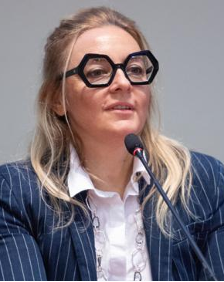
Chiara Bisio is Associate Professor of Physical Chemistry at the Department of Sciences and Technological Innovation of the University of Piemonte Orientale (UPO). Since November 2024, she also serves as the Rector’s Delegate for Orientation and Tutoring at UPO. She graduated cum laude with special mention in Chemistry from UPO in 2001 and obtained her PhD in Chemical Sciences in 2005 under a joint-supervision agreement between the University of Turin (Italy) and Pierre and Marie Curie University (Paris, France). She has maintained a strong long-term scientific collaboration with the CNR-SCITEC Institute of Chemical Sciences and Technologies in Milan, where she served as a Research Associate from 2009 to 2025. She is the Chair of the International Advisory Board for the International Symposium on Intercalation Compounds (ISIC), a member of the Scientific Committee of CRIMEDIM (Research Center in Emergency and Disaster Medicine), and member of the Joint Technical-Scientific Committee of the RisPA Center (Research and Development Centre for Environmental Remediation and Protection, established in 2024 in collaboration with Syensqo). Recently, she was elected Fellow of the Academy of Sciences of Turin. Her research interests focus on the synthesis, physico-chemical characterization, and functional tuning of porous and layered solids with controlled morphology, chemical composition, and surface properties. These functional materials are developed for environmental and energy applications, including heterogeneous catalysts for the degradation of toxic agents, emerging pollutants, and biological hazards. She authored over 120 publications, 3 book chapters, and 2 patents.